

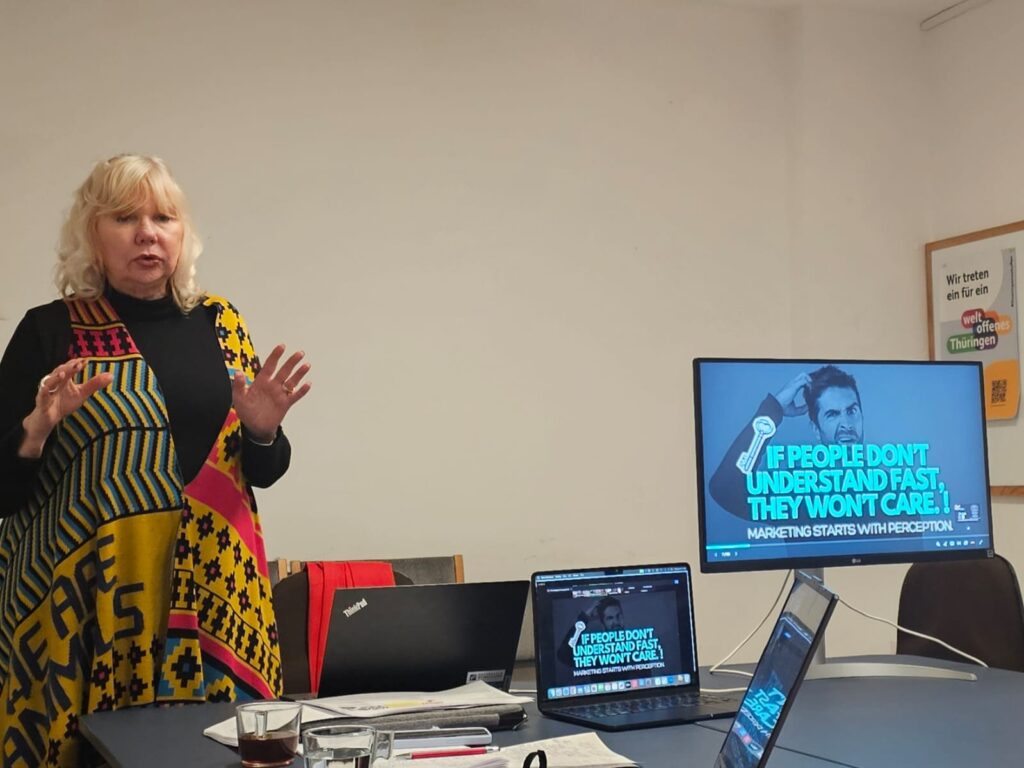
On Wednesday, January 14th, the Social Impulse Hub hosted its fourth module of the Business Skills Program at Salinenstraße 34 in Erfurt, continuing the hands-on learning journey of the Social Impulse Academy with a workshop focused on marketing for startups. Facilitated by business developer, enthusiastic innovator, international speaker and university professor, Katharina Wassink, the session brought together aspiring entrepreneurs to explore how marketing can support trust-building, and clear value communication.
The workshop opened with a short introduction, followed by an exchange of startup ideas among participants. Entrepreneurs shared their concepts, while those already running startups offered reflections on their real-world struggles, from finding the right audience to balancing visibility with limited resources. This exchange grounded the session in lived experience and highlighted shared challenges across different stages of trust and development.
Participants were then invited to introduce themselves through 30-second to one-minute pitch talks, a concise exercise that encouraged clarity and focus. These quick pitches allowed participants to articulate their ideas sharply while receiving immediate impressions from peers.
The core of the workshop centered on marketing as a process of learning, trust, and communication, not merely promotion. Participants explored how marketing helps the right people understand, trust, and act, emphasizing relevance over reach. Through guided reflection, they conducted a reality check on their current efforts: where their energy is being invested, where genuine interest is coming from, and what fears may be shaping their decisions.
Building on this reflection, participants were encouraged to define the nature of their ventures, whether service-based, social enterprises, or tech startups, and to articulate their value proposition in a single sentence, tailored to either B2B or B2C audiences. This exercise helped sharpen messaging and uncover gaps in positioning.


The session also addressed common reasons for startup failure, particularly those linked to unclear value propositions, weak customer understanding, and ineffective communication. Participants discussed startup marketing red flags and green flags, identifying early warning signs as well as positive indicators of alignment and traction.
A key discussion focused on trust signals in startup marketing, examined through the lens of participants’ own ventures. Through open dialogue and peer feedback, participants reflected on what builds credibility,from transparency and consistency to social proof, and how trust can be intentionally communicated. These insights were then connected to an overview of marketing channels for startups, helping participants identify where and how their target audiences are most effectively reached.
Moving from strategy to action, the workshop introduced promotion strategies, emphasizing clarity around what actions to take and how to implement them. Participants were encouraged to work on developing a 30-day marketing plan, supported by a visual 30-day grid that translated ideas into concrete, time-bound steps. To enrich this process, the Six Thinking Hats method was introduced to examine marketing plans from multiple perspectives, encouraging balanced and critical decision-making.
By the end of the session, participants left with clearer messaging, actionable marketing plans, and a stronger understanding of how trust and communication shape startup success. As the Business Skills Program continues, workshops like this play a vital role in equipping entrepreneurs with practical tools, reflective frameworks, and peer support to build resilient and meaningful ventures.
The project has been co-funded under the Interreg Central Europe program of the European Union through the project “TASK4ISI” – Transnational Action to advance SKills and competences FOR Inclusive entrepreneurship and Social Innovation.