
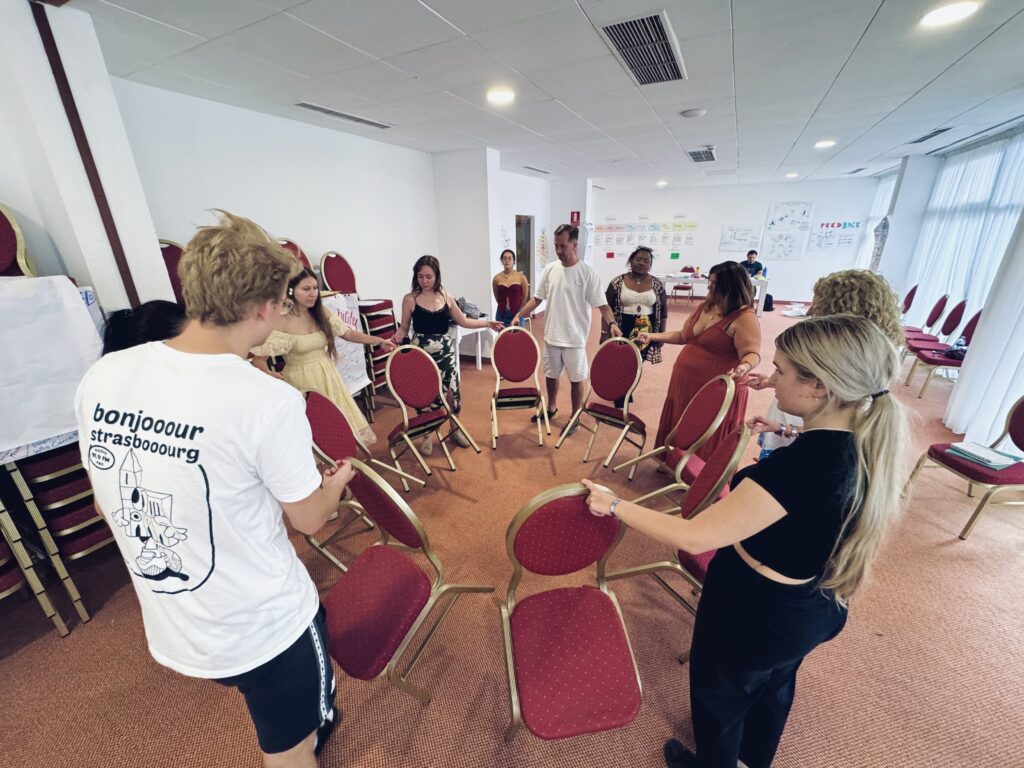
Coming into Part 2 of the long-term Training of Trainers “Facilitation Guide” (04–12 October 2025, Tenerife, Spain), I had a clear feeling: this was not going to be a continuation in the usual sense. Part 1 in Weimar gave us foundations and language. The local phase forced us to test that language in real contexts. Tenerife was the moment where everything had to work under pressure, with real time constraints, complex group dynamics, and the responsibility of facilitating something that genuinely serves participants.
The infopack describes Part 2 as the “advanced” stage of the project, focused on deeper competence-building in facilitation and training, and continuous personal and professional development. That’s exactly how it felt: less “content delivery,” more precision work, on ourselves, on our methods, and on how we read groups.
Tenerife as a learning space (and why it mattered)
We were based in Puerto de la Cruz, hosted at Hotel Puerto Resort. Arrival was planned for 04 October and departure for 12 October, which created a clear container: the week was designed for full participation, not drop-in attendance.
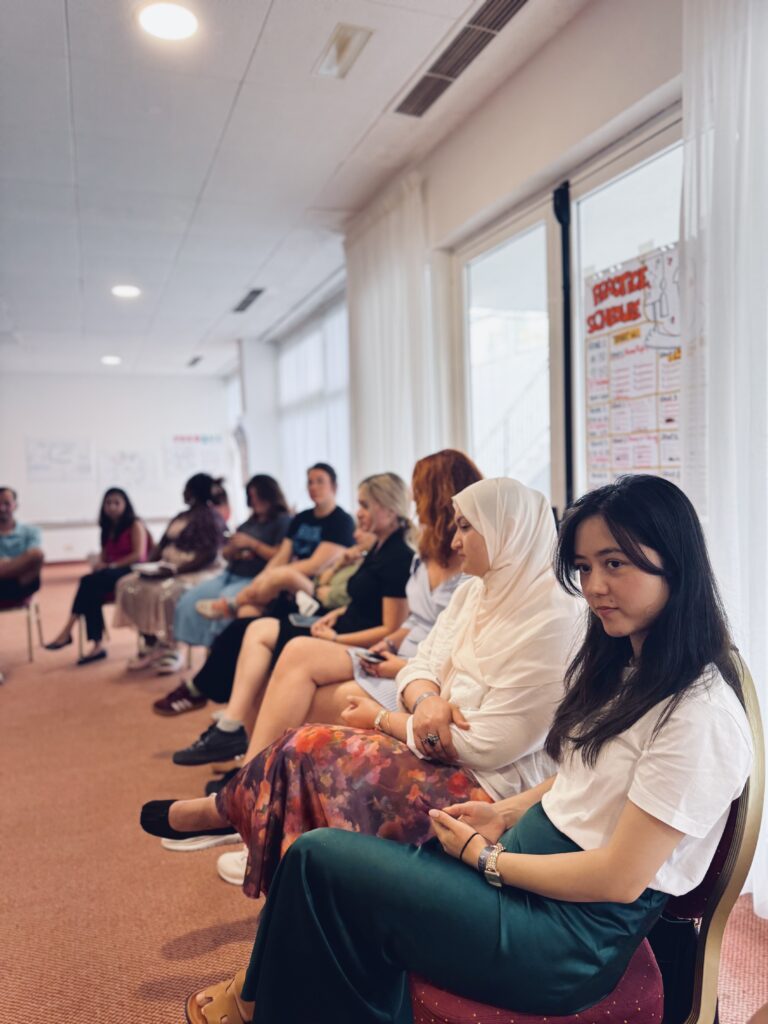
This matters for colleagues who haven’t attended these courses: facilitation training is not only about what we learn, but how the environment holds us while we learn. Tenerife gave us that combination of intensity and recovery. Sessions were demanding, yet the setting supported informal reflection, those moments where you realise, over dinner or during a short walk, what actually happened in the room.
From “learning about facilitation” to “facilitating for real”
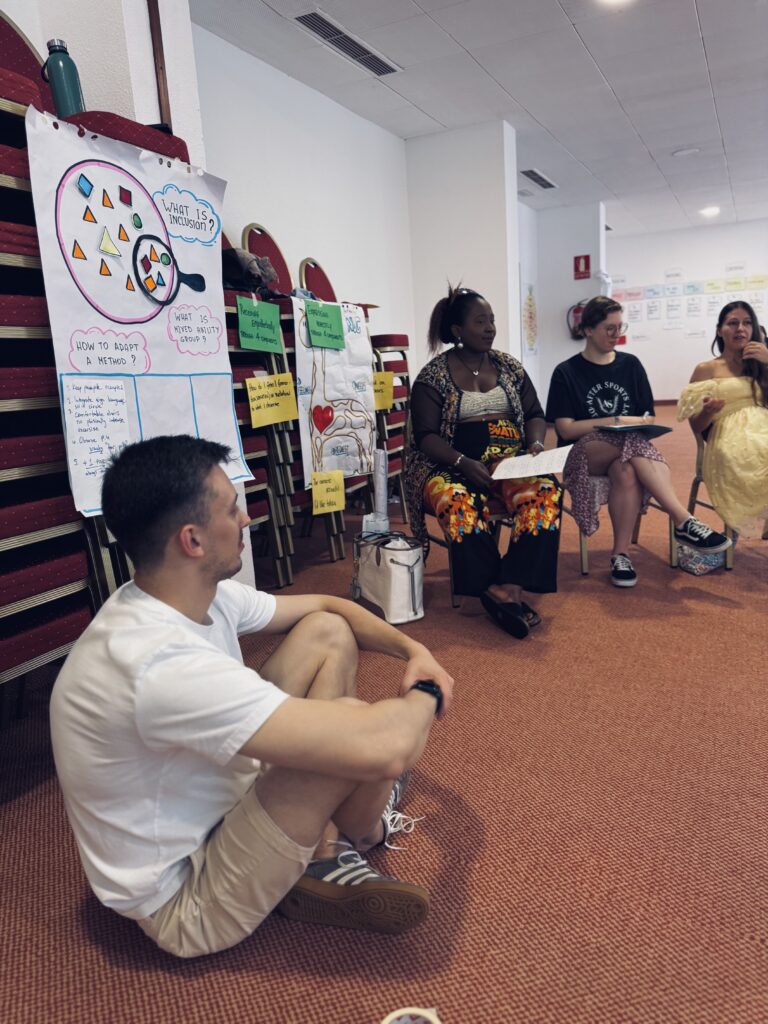
The visual language of the training made the message unavoidable: it was time to act. One of the flipcharts literally addressed us as facilitators—“it is time to facilitate and time for you to act”—and pushed us into a practice mode: form groups, pick a task, prepare, and deliver. That tone set the whole second part: we were not there to discuss facilitation as an abstract concept; we were there to perform it, receive feedback, and do it again—better.
Another flipchart captured the underlying logic of the practice block: develop and implement a session/workshop on a useful, practical topic for facilitators, under a set of constraints (topic and challenge elements), with attention to place, time, materials/resources, and participation—followed by feedback and evaluation. This framing was simple, but it mirrored real youth work: we rarely work under ideal conditions, and our professionalism shows in how we design despite constraints.
Practice rounds: structure, timing, feedback culture
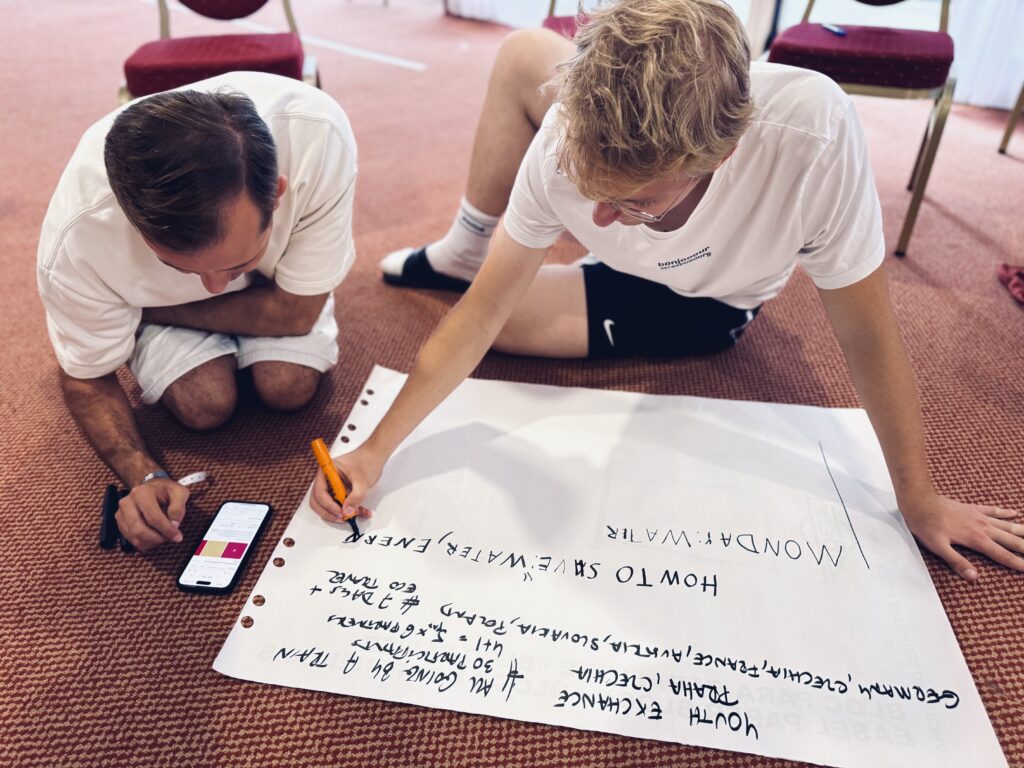
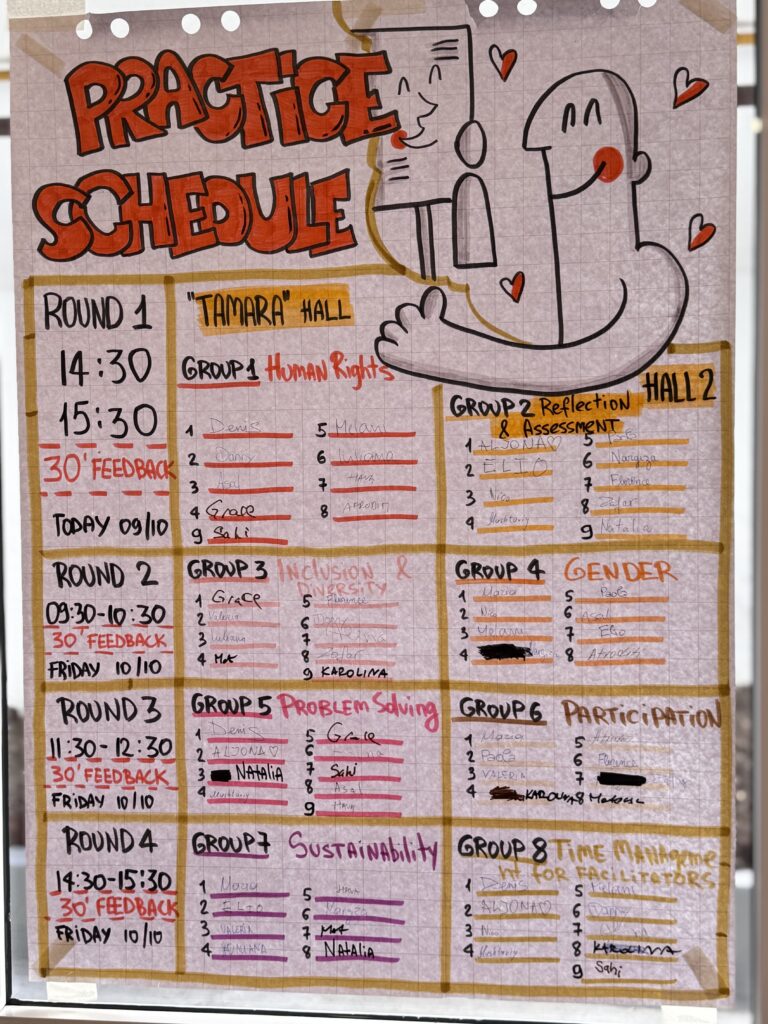
A practical schedule board mapped several rounds of parallel sessions with built-in feedback time. What I took from that structure is not only the logistics, but the message it sends: facilitation improves throughdeliberate repetition and honest feedback. The design treated feedback as an essential learning method—not as an “extra” at the end.
For our team at CGE, this is one of the most transferable elements: if we want stronger facilitation internally, we need to normalise structured peer feedback in our trainings and youth activities. Not informal “good job,” but feedback that looks at instruction clarity, pacing, inclusion, and learning outcomes.
Conflict competence: naming what happens before it escalates
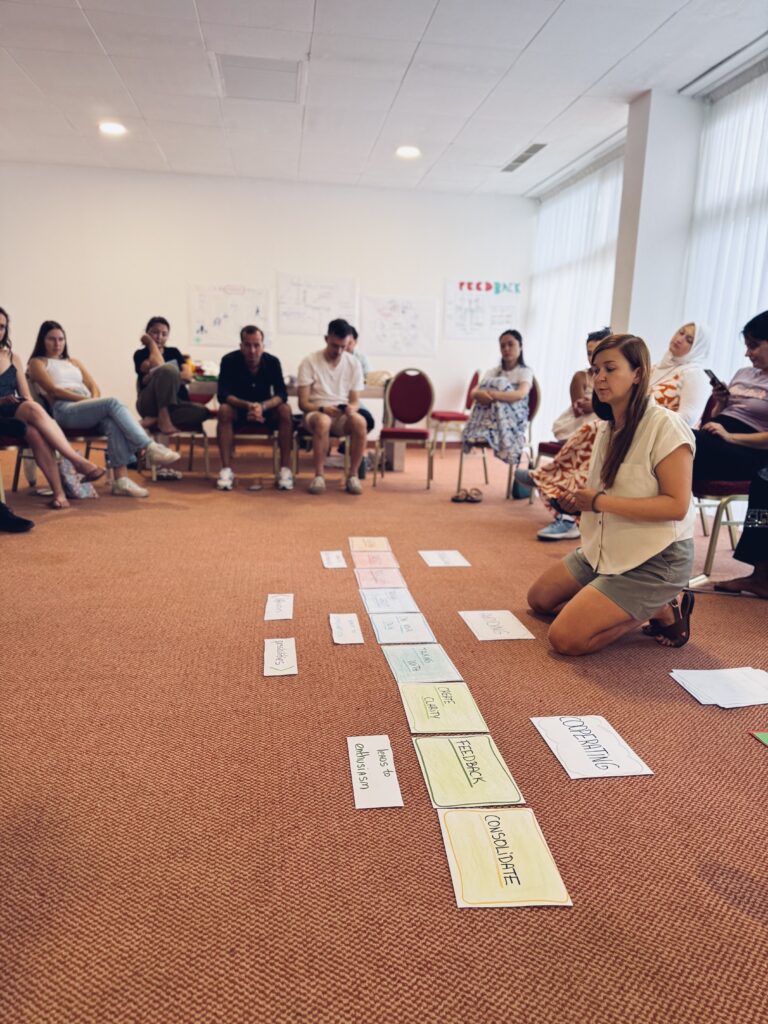
One wall stayed with me because it described group dynamics in a way that is both accessible and precise. The visual model mapped a progression from struggling to avoiding to cooperating:
- early signs (trouble starts; conflict between parties; blame/irritation),
- what avoidance looks like (complaining about others, working separately, indirect hints),
- and what cooperation requires (transparent curiosity, creating clarity, feedback, a safe learning environment, and eventually stronger performance).
As facilitators, this is practical intelligence. Many conflicts in groups don’t erupt loudly—they leak through side conversations, disengagement, or “polite compliance.” The Tenerife work reminded me that facilitation is also early intervention: reading the room, naming patterns before they harden, and creating conditions for the group to return to shared purpose.
Identity and inclusion: going beyond the visible layer
We also worked with tools that help groups explore identity without reducing people to labels. The “identity onion” flipchart was a strong anchor: it shows how visible elements (style, clothes, language, appearance, food, music) sit on outer layers, while deeper layers involve social roles, rituals, heroes, and ultimately values and beliefs at the core. The relevance for inclusion work is immediate: if we only design for what we can quickly see, we miss what actually shapes participation and safety.
In practice, this supports better facilitation choices—how we form groups, how we frame questions, what we treat as “normal,” and how we hold disagreement. It also pushed us to reflect on our own defaults as educators: what do we interpret too fast, and what do we fail to ask about?

Communication under pressure: the NVC “giraffe” as a facilitator tool
A final image I keep thinking about is the Nonviolent Communication (NVC) giraffe, structured around four steps: Observe (without judgement), Feelings, Needs, Request. In youth work, “communication tools” can sometimes feel like add-ons. Here it was positioned as facilitation infrastructure: if we want safe learning spaces, we need a shared way to express tension and needs without blaming or diagnosing others.
For our daily practice at CGE, this is one of the clearest takeaways: when facilitation gets difficult, the quality of our language becomes the quality of our intervention. The giraffe model is a simple scaffold we can integrate into debriefings, conflict moments, or team agreements—especially in multicultural groups where misunderstandings escalate quickly.
How Part 2 connects back to the whole project
The infopack summarises the broader project aim clearly: building youth workers’ competences in organising, implementing, and evaluating engaging educational activities, and strengthening self-assessment and professional development. The objectives include developing essential facilitation competences, exploring inclusive tools, increasing awareness of our own values and communication patterns, and promoting networking and follow-up initiatives.
Part 2 delivered on that promise—not by giving more theory, but by increasing the stakes of practice. It treated facilitation as something you demonstrate through design choices, presence, ethical judgement, and the ability to build learning conditions for others.
What I’m bringing back to colleagues at CGE
If I had to translate this week into a message for our team, it would be:
- Practice is the curriculum. We should create more spaces where we practise facilitation in short cycles and get feedback.
- Inclusion is designed. Identity work, group agreements, and conflict competence are not “soft extras”—they are structural elements of quality youth work.
- Communication is a facilitation tool. NVC-style language helps us intervene earlier and with more care when tensions appear.
- Clarity reduces friction. A clear frame—purpose, timing, tasks, and feedback—creates safety and frees energy for learning.
Part 1 gave us the map. Part 2 made us walk it—together, and sometimes with shaky legs, but with enough trust and structure to keep going. And that, for me, is exactly what a long-term training of trainers should do.